

Do Endothermic Reactions Feel Cold
Has this always happened to you? You are running in gym class and yous twist your ankle. It hurts and starts to swell up. Your teacher grabs the first assistance kit and pulls out an instant cold pack. Afterwards one good clasp, the pack becomes really common cold, almost instantly. What is happening? How practise the chemicals make the pack cold and so quickly? The answer can be found in thermodynamics! This is a branch of scientific discipline that explores the transfer of free energy. In thermodynamics, chemical reactions can be classified as eitherendothermic orexothermic.
What are the two chief types of thermodynamic reactions?
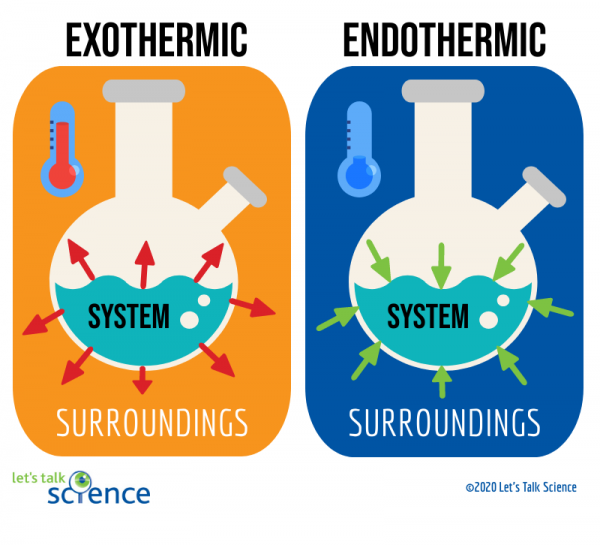
Exothermic reactions are reactions that release energy in the form of heat. You are probably familiar with many examples of these reactions. For example, called-for gasoline in a car's engine is an exothermic reaction. This particular blazon of exothermic reaction is known equally acombustion reaction. A combustion reaction occurs when a chemical compound, such as the hydrocarbons that brand up fuel, react with oxygen to form a new product and produce heat.
Endothermic reactions are the opposite of exothermic reactions. They blot heat energy from their environment. This means that the surround of endothermic reactions are colder as a result of the reaction. Melting water ice is an case of this type of reaction.
How do y'all know what type of thermodynamic reaction is happening?
One way to do this is by looking at the organisation and surround of a reaction. Theorganization is where the reaction takes place, and thesurroundare the area effectually the system.
To determine if a reaction is exothermic or endothermic, yous could:
- measure the temperature change of the system or its environment, or
- summate the energy of the arrangement.
Of these ii methods, measuring the temperature change is easier. To practice this, you simply measure the temperature of a reaction before and afterward it is completed. Since information technology tin sometimes be difficult to measure the temperature within the system of a reaction, scientists oftentimes measure out the temperature of the environment instead.
It is possible to predict whether a reaction volition be endothermic or exothermic by doing a little math. For this, it helps to know a bit most chemic reactions and chemical bonds.
In that location are two sides to any chemic reaction. On one side are thereactants. A reactant is the substance (or substances) that you lot start with. On the other side are theproducts. A product is the substance, or substances, that you finish up with subsequently the reaction happens.
In a chemical reaction, the chemic bonds in thereactantmolecules arebroken. New bonds areformed in theproduction molecules. An instance would exist the combustion reaction betwixt methane (CH4) oxygen (Otwo) (the reactants) that produces carbon dioxide (COii) and water (Htwo0) molecules (the products). Bonds are broken in the methane and oxygen molecules. Bonds are formed in the carbon dioxide and water molecules.
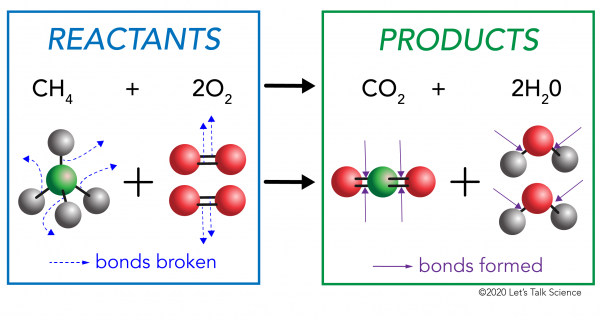
What is important to know is thatenergy is needed to both make and to intermission bonds. To determine if a reaction is exothermic or endothermic, y'all have to compare the amount of energy needed to break the bonds of the reactants to the amount of free energy released when new bonds are made. If the amount of energy released when the new bonds are formed in the products is greater, then it is an exothermic reaction. If the amount of free energy needed to suspension the bonds of the reactants is greater, then it is an endothermic reaction.
Ane mode to show this is using an free energy diagram. Energy diagrams show the energy levels of reactants and products in a reaction.
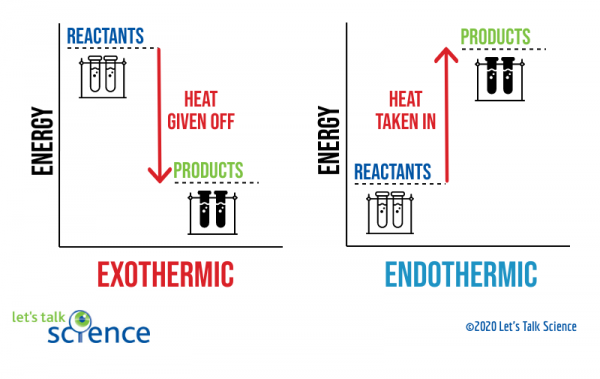
Yous can come across from the diagram above that the free energy level of the products of an exothermic reaction is lower than the energy level of the reactants. Thedifferencebetween the energy levels of reactants and products is called theenthalpy change (ΔH). In an exothermic reaction, the ΔH is NEGATIVE. In an endothermic reaction, the ΔH is POSITIVE.
Did you know?
Scientists can measure energy in foods past measuring how much estrus the food releases when it is burned. They measure this using a tool called a bomb calorimeter.
It is possible to calculate ΔH without fifty-fifty doing an experiment! Scientists have determined experimentally the energies required to make and break specific molecular bonds. These energies are known asaverage bond energies.
| O=O | 119 kcal/mol |
| C-H | 99 kcal/mol |
| O-H | 111 kcal/mol |
| C=O (in CO2) | 192 kcal/mol |
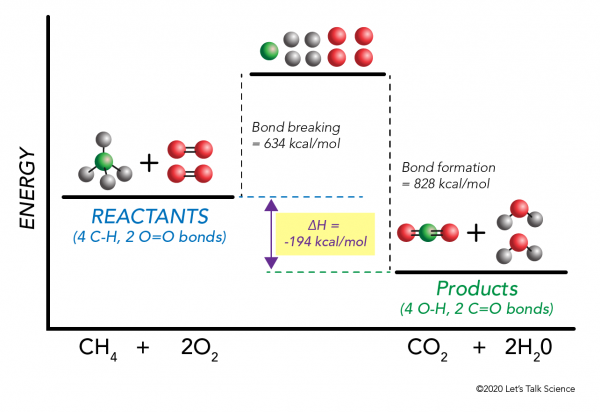
Using the marsh gas combustion example again, the math works like this:
ΔH = [energy used in reactant bail breaking] - [free energy released in product bail making]
= [ 4 C-H bonds + ii O=O bonds] - [four O-H bonds + 2 C=O bonds]
= [(4 x 99 kcal/mol) + (2 ten 119 kcal/mol)] - [(4 x 111 kcal/mol) + (ii x 192 kcal/mol)]
= [396 + 238] - [444 + 384]
= 634 - 828
= - 194 kcal/mol
Since the enthalpy change is negative, we know that the reaction volition exist exothermic.
How practise thermodynamics piece of work in a cold pack?
Now, let's get back to our instant cold pack. An instant cold pack is the perfect example of an endothermic reaction. There are many possible ingredients in an instant common cold pack, merely they ofttimes contain solidammonium nitrate and water.
Did you know?
Ammonium nitrate is a nitrate salt. It is heavily used in agriculture as a fertilizer. Information technology is likewise used as an explosive in the mining industry.
The ammonium nitrate is stored in a sealed plastic handbag that is surrounded past water. When you lot pop the purse, the ammonium nitrate comes into contact with water anddissolves.
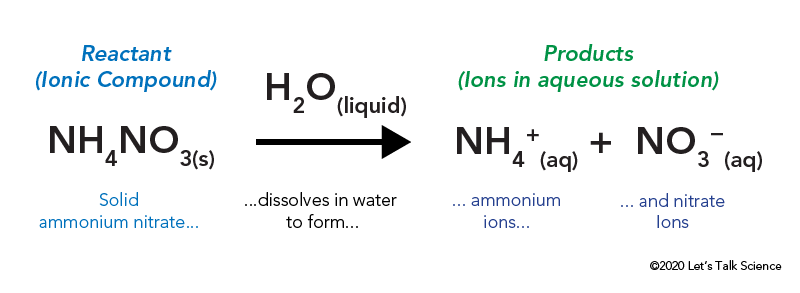
Dissolving anionic chemical compound, like table salt or ammonium nitrate, involves free energy. Like other types of reactions, heat energy may be given off or taken in when the fabric dissolves. This energy is called theenergy of solution and tin be written asΔH soln .
ΔHsoln = ∑ΔH [products] - ∑ΔH [reactants]
Rather than working out the ΔH for the reactants and products using bond energies, scientists often employ pre-calculated values onStandard Enthalpy of Formation (ΔH° f )tables. From such a table nosotros learn that:
| ΔH° f | kJ/mol |
|---|---|
| NH4 + (aq) | -132.8 |
| NH4NO3(s) | -365.i |
| NOiii - (aq) | -206.6 |
Allow's do the math to calculate the energy of solution
ΔHsoln = ∑ΔH [products] - ∑ΔH [reactants]
= [ mol (NH4 + (aq)) + mol (NO3 - (aq)) ] - [ mol (NH4NOthree(south)) ]
= [ (ane mol)(-132.8 kJ/mol) + (1 mol)(-206.6 kJ/mol) ] - [ (1 mol)(-365.one kJ/mol) ]
= - 339.4 + 365.1
= 25.seven kJ
Call back at the beginning we said that ifΔH is NEGATIVEthe reaction is exothermic and that ifΔH is POSITIVEthe reaction is endothermic? Well, that also applies to free energy of solution problems. Since we calculated that the ΔHsoln was positive (25.7 kJ), the reaction must be endothermic. We know this to exist true because the common cold pack made its surroundings very cold!
Summing up...
Exothermic and endothermic reactions are important for our chemical globe. These reactions tin can help keep us warm past giving off energy (exothermic) or help cool u.s.a. downward by taking in energy (endothermic).

Do Endothermic Reactions Feel Cold,
Source: https://letstalkscience.ca/educational-resources/stem-in-context/cold-pack-a-chilly-example-endothermic-reaction
Posted by: huntcounce.blogspot.com
0 Response to "Do Endothermic Reactions Feel Cold"
Post a Comment